
Sri Lanka continues to face a broad spectrum of maritime security threats, including smuggling, human trafficking, marine pollution offences, illegal migration by sea, and maritime border violations. While these challenges persist across the maritime domain, the most significant and highly publicised issues during this year have abeen the marked escalation in drug trafficking and Illegal, Unreported, and Unregulated (IUU) fishing. These two threats have not only increased in frequency and scale but have also had the greatest impact on national security, economic stability, and regional maritime governance. Under the Government’s vision of “A Nation United,” the Sri Lanka Navy working closely with multiple other relevant entities such as the Sri Lanka Coast Guard (SLCG), Police Narcotics Bureau (PNB), Sri Lanka Police and Special Task Force (STF), State Intelligence Service (SIS), Criminal Investigation Department (CID), Department of Fisheries and Aquatic Resources (DFAR), Sri Lanka Customs, Sri Lanka Ports Authority (SLPA) and several international partners like India, International Criminal Police Organization (INTERPOL) and United Nations Office on Drugs and Crime (UNODC) has stepped up operations, making numerous high profile arrests throughout 2025. Despite these successes, evolving threats and operational gaps highlight the need for a strengthened, future ready maritime security strategy.
The most recent initiative by the Government took place on 11 November 2025, when a high level meeting was convened under the patronage of the Minister of Fisheries, Aquatic and Ocean Resources, the Minister of Justice and National Integration, the Deputy Minister of Defence and other relevant Government high level officials. The key meeting was focused on preventive measures, law enforcement responses, and inter-agency cooperation to counter illegal fishing and poaching in Sri Lankan waters.
In light of the current context, this article examines recent operations, identifies emerging threats, and provides strategic recommendations to enhance Sri Lanka’s maritime security posture.
Rise of drug trafficking and IUU fishing in Sri Lanka’s maritime domain
A sharp increase in narcotics trafficking was evident from 2024 to 2025. In one of the earliest major operations of the year, the Navy in May 2025 apprehended 11 individuals aboard two local trawlers carrying 275.6 kg of heroin and 503.6 kg of methamphetamine. (Sri Lanka Navy, 2025)
On 14 October 2025, another significant breakthrough occurred when naval personnel discovered 51 abandoned sacks containing 839 kg of narcotics, including heroin, hashish, and methamphetamine in southern waters, marking one of the largest maritime drug seizures of the year. (Sri Lanka Navy, 2025)
Later, from 21 to 24 October 2025, naval units operating in Trincomalee and Jaffna detained six individuals involved in illegal fishing practices, including the use of unauthorised nets, along with four dinghies (fibre-glass boats). (Sri Lanka Navy, 2025)
Subsequently, on 2 November 2025, a multi-day fishing trawler intercepted off the western coast was found carrying over 250 kg of methamphetamine and 85 kg of heroin, with six suspects handed over to the Police Narcotics Bureau for further action. (Sri Lanka Navy, 2025)
This was followed by a series of illegal fishing incidents: On 02 to 03 November 2025, the Sri Lanka Navy and Coast Guard apprehended four Indian fishing vessels and 35 fishermen poaching near Veththalakerni and Analativu in Jaffna. (Sri Lanka Navy 2025)
Furthermore, another 14 Indian fishermen were arrested on 9 November 2025 during a separate operation. By mid-2025, these coordinated enforcement efforts had resulted in the seizure of more than 544 kg of heroin and 1,217 kg of methamphetamine, underscoring Sri Lanka’s growing exposure to transnational narcotics trafficking. (Sri Lanka Navy, 2025)
Collectively, these incidents highlight the dual threats faced by the nation which are, international drug smuggling networks exploiting maritime routes and persistent illegal fishing that threatens Sri Lanka’s marine resource.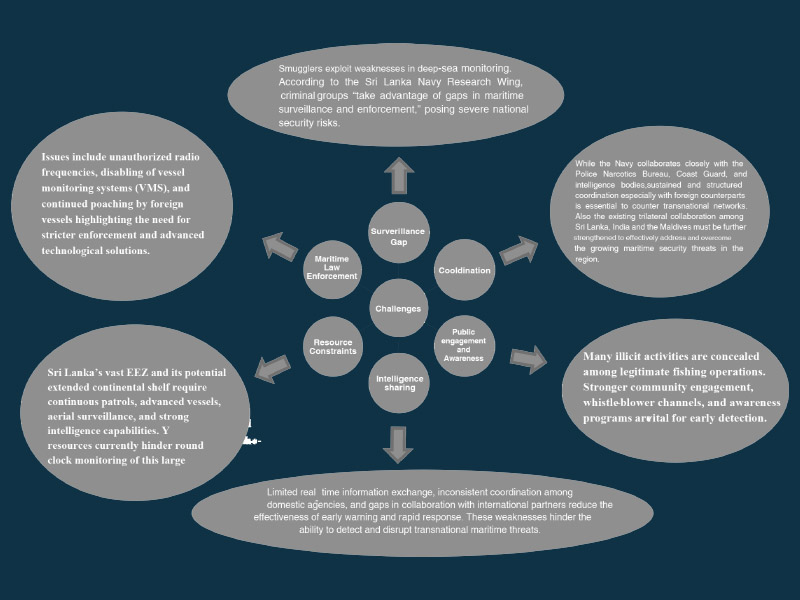
Strengths and capabilities of the Sri Lanka Navy
Despite growing challenges in the maritime domain, the Sri Lanka Navy continues to demonstrate remarkable strength and operational proficiency. Recent high profile narcotics interceptions highlight the Navy’s effective use of intelligence, gathered through strong cooperation with both domestic and international partners. These missions are further reinforced by close inter-agency coordination with the Police Narcotics Bureau, State Intelligence Service, Coast Guard, and other key agencies, ensuring a unified and timely response to emerging threats.
The Navy’s fleet of Offshore Patrol Vessels and Advanced Offshore Patrol Vessels has also expanded its deep sea operational reach, enabling long range surveillance and interdiction far beyond coastal waters. Sri Lanka’s maritime security capability has been significantly strengthened in recent years, with the Navy receiving advanced surveillance drones from Japan, high performance patrol vessels from Australia, a U.S. donated offshore patrol cutter, and critical spare part support from India, enabling more effective monitoring of sea lanes, rapid response to maritime threats, and sustained protection of the nation’s territorial waters.
The annual International Maritime Boundary Line (IMBL) meeting between the Sri Lanka Navy and Coast Guard and their Indian counterparts has become a vital pillar in strengthening Sri Lanka’s maritime security architecture. This long-standing mechanism enhances operational coordination, promotes real-time information sharing, and helps both Navies jointly address pressing challenges such as illegal fishing, smuggling, narcotics trafficking, and maritime search and rescue operations.
Equally important is the Navy’s ongoing engagement with fishermen and coastal communities, encouraging them to report suspicious activities; a vital human element that strengthens national maritime security through shared vigilance.
Strategic recommendations to develop future maritime security
To effectively counter emerging maritime threats, Sri Lanka must adopt a long-term and technologically integrated strategy. Strengthening Maritime Domain Awareness (MDA) is essential, and the Sri Lanka Navy can enhance surveillance by deploying UAVs and drones for continuous monitoring, use of SLAF support for coastal surveillance, utilising satellite-based systems for long-range vessel tracking, and incorporating AI-driven analytics for predictive threat assessment and abnormal vessel behaviour detection.
Improved inter-agency and international cooperation is equally vital, including formalised joint task forces between the Navy, Coast Guard, Police Narcotics Bureau (PNB), and State Intelligence Service (SIS), as well as expanded intelligence-sharing with regional partners and global organisations such as UNODC and INTERPOL.
Regular multinational and joint naval exercises focusing on narcotics interdiction and IUU fishing prevention will further strengthen operational readiness. Capacity building must also be prioritised through investment in modern patrol craft, fast interceptor vessels, upgraded coastal radar systems, and advanced training for naval personnel in maritime intelligence, digital forensics, and counter-smuggling operations.
Partnerships with developed nations for technological developments with advanced training can support real-time maritime monitoring and prompt actions.
Strengthening key regional maritime security initiatives such as Colombo Security Conclave (CSC) comprising Sri Lanka, India and the Maldives to discuss and formalise cooperation in areas including maritime safety and security, counter-terrorism and radicalisation, organised crime (trafficking, arms, drugs), cyber-security, protection of critical infrastructure, humanitarian assistance, disaster relief, and broader cooperation on maritime law, marine pollution, hydrography/ oceanography and such.
Further enriching the effectiveness of the annual IMBL meeting is the inclusion of high-level Government stakeholders alongside naval and coast guard representatives.
Participation by senior officials from the Ministry of Defence, Fisheries, Foreign Affairs, and relevant maritime regulatory bodies would help align operational level discussions with national policy priorities and ensure faster decision-making on sensitive cross border issues.
Finally, enhancing community engagement is crucial; targetted awareness programmes for fishing communities, secure anonymous reporting mechanisms, and the provision of alternative livelihood opportunities will help deter local involvement in smuggling and foster greater public cooperation in safeguarding Sri Lanka’s maritime domain.
Conclusion
The dramatic rise in drug trafficking and illegal fishing has made Sri Lanka’s maritime environment increasingly complex. While the Sri Lanka Navy has demonstrated remarkable capability through intelligence led operations, major narcotics seizures, and inter-agency collaboration the scale of the threat requires a strategic shift. A technologically advanced, collaborative maritime security framework is essential to safeguard Sri Lanka’s national interests. Through sustained commitment, enhanced surveillance, regional cooperation, and community engagement, Sri Lanka can strengthen its defences against transnational maritime crime and ensure the long-term security of its waters.
Commander (G) S.L. Wickramasinghe, psc, MSc (D&SS), BNavalSt (Maritime Warfare), PG Dip Def Mgt is a Military Research Officer at the Institute of National Security Studies established and functioning under the Ministry of Defence. The opinions expressed are his own and not necessarily reflective of the institute or the Ministry of Defence.