
A new maritime giant emerges in the Indian Ocean
The Indian Ocean has always been the most travelled maritime highway in the world connecting Asia, Europe, Africa and the Middle East for centuries. Sri Lanka is strategically placed on the East-West Sea Lines of Communication (SLOCs) and is fortunate to find itself in the middle of this vast ocean. But a new offshore development is emerging only a few hundred nautical miles away that could dramatically change the strategic and economic picture of the region. India’s construction of International Container Transshipments Port (ICTP) or Galathea Bay Port at Great Nicobar Island could have a major impact on the nautical destiny of Sri Lanka.
Source: Author's own work (created with assistance from Open AI, 2026).
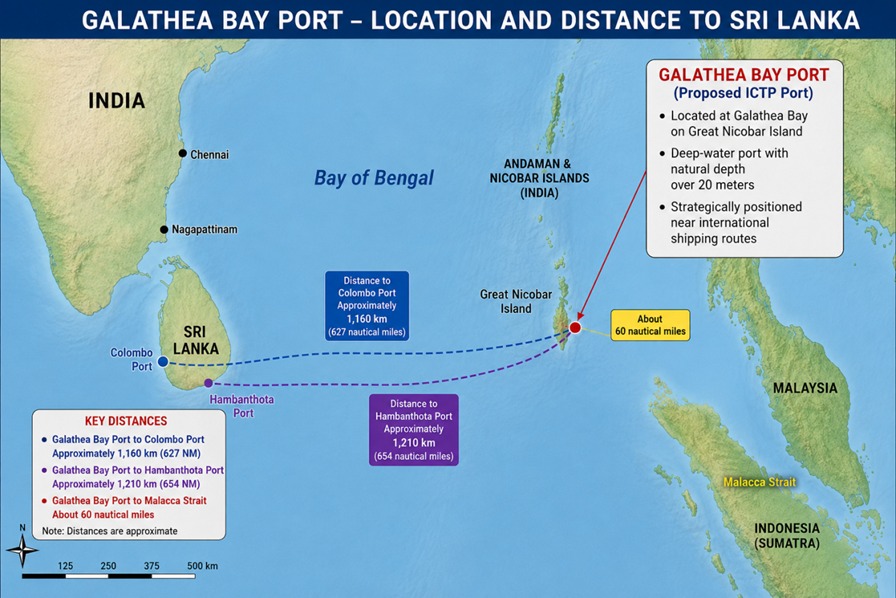
The proposed deep-water port is to be built near Galathea Bay on Great Nicobar Island in the Bay of Bengal, a mere 40 nautical miles from one of the world’s most important maritime chokepoints the Malacca Strait (Drishti IAS, 2024). The Galathea Bay port lies approximately 1,160 km (627 nautical miles) from the Port of Colombo and about 1,210 km (654 nautical miles) from the Port of Hambantota, making it one of the closest major Indian deep-water ports to Sri Lanka. The port is a part of India’s massive Great Nicobar Island Development Project and is slated to begin operations in 2028.
Source: Detailed Project Report (DPR) prepared for the International Container Transshipment Terminal (ICTT) at Galathea Bay.
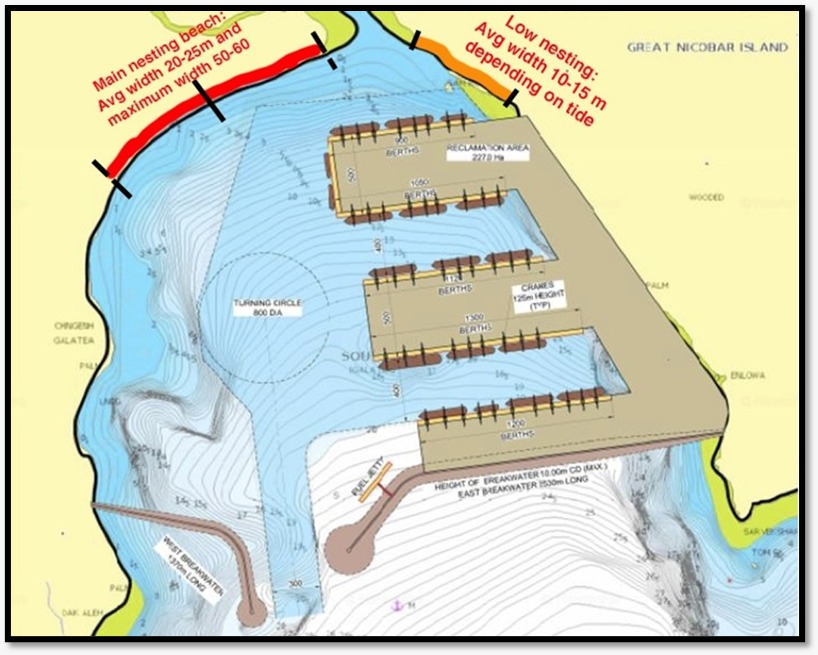
The proposed deep-water port at Great Nicobar is designed to accommodate ultra-large container vessels, benefiting from a natural depth exceeding 20 metres. The project aims to establish India as a major transshipment hub in the Indian Ocean while reducing its dependence on foreign transshipment ports, particularly Port Klang, Singapore, and Colombo, which currently handle a significant share of India's transshipment cargo (Government of India, 2021; EY India, 2024).
Sri Lanka: The traditional gateway of the East-West sea lanes
On the East-West Sea Lines of Communication, every year about approximately 60,000 ships pass south of Sri Lanka (Wijesinha, 2016; Lakshman Kadirgamar Institute, 2020). These routes handle some half of the world’s container traffic and two thirds of its oil shipments. “Colombo Port has taken advantage of its location and developed itself to become the leading transshipment hub in South Asia (United Nations Conference on Trade and Development, 2023; Sri Lanka Ports Authority, 2024).
At present transshipments cargo makes up over 70% of the container volumes at Colombo Port, of which Indian freight accounts for over 45%. Colombo Port, despite regional rivalry, experienced rapid growth in 2025, with over 5.4 million Twenty-foot Equivalent Units (TEUs) carried in just eight months (Sri Lanka Ports Authority, 2024; Central Bank of Sri Lanka, 2025).
How Sri Lanka benefited from India's lack of deep-water harbours
Although India possesses a coastline of more than 7,500 km, it historically lacked sufficient natural deep-water facilities capable of accommodating the latest generation of ultra-large container vessels (Government of India, 2021; Drishti IAS, 2025). Consequently, a significant proportion of India's transshipments cargo was routed through regional hubs, particularly the Port of Colombo, contributing substantially to Sri Lanka's maritime economy.
However, Sri Lanka's proximity to India has produced mixed outcomes. While it has enabled Colombo to emerge as South Asia's leading transshipments hub, it has also exposed Sri Lanka to strategic, economic, and geopolitical vulnerabilities arising from its dependence on Indian cargo and its location within a region of intensifying great-power competition. The development of India's deep-water ports, including the proposed Great Nicobar International Container transshipment Terminal and the Vizhinjam International Seaport reflects New Delhi's efforts to reduce its reliance on foreign ports and may significantly reshape regional transshipment patterns.
Galathea Bay and the changing maritime landscape
When India realized how dependent it was, it began planning to construct its own excellent deep water transshipment ports. With the opening of Vizhinjam Port on the western bank, Galathea Bay became India's eastern entrance. The natural port's and strategic location near international shipping routes offer lower logistics costs, more trade competitiveness, and greater maritime autonomy for India.
The proposed Galathea Bay International Container Transshipment Port (ICTP) is expected to reshape regional transshipment patterns by attracting container traffic currently handled by major hubs such as Singapore, Port Klang, and Tanjung Pelepas. Located approximately 60 nautical miles from the Malacca Strait, the port offers a strategic location with minimal deviation from major East–West shipping routes, potentially reducing transit time and operational costs (MoPSW, 2024). Although Singapore is likely to retain its position as the leading global maritime hub, Galathea Bay is expected to increase regional competition and enhance India's maritime influence and transshipment capabilities in the Indo-Pacific (UNCTAD, 2024).
Maritime security: Opportunities for Sri Lanka and IndiaThe development of the Galathea Bay Port should be viewed not solely through the lens of Sri Lanka–India competition but as an opportunity to strengthen regional maritime security cooperation. The Andaman Sea has become increasingly vulnerable to illegal, unreported and unregulated (IUU) fishing, narcotics and arms trafficking, human smuggling, maritime piracy, and marine pollution due to its proximity to the Malacca Strait (UNODC, 2023; IORA, 2023). Enhanced cooperation between Sri Lanka and India in maritime domain awareness, intelligence sharing, coordinated patrols, search and rescue, humanitarian assistance and disaster relief (HADR), and logistics support would improve maritime governance and regional stability.
The evolving strategic environment in the Bay of Bengal has also encouraged greater naval modernisation. Bangladesh has expanded its underwater capability through the acquisition of two Ming-class submarines, while Pakistan has pursued the induction of Hangor-class submarines to strengthen its maritime deterrence. Extra-regional naval deployments, including submarine operations by major Indo-Pacific powers, further underline the strategic importance of the region (SIPRI, 2024; IISS, 2025). These developments reinforce the need for closer Sri Lanka–India cooperation in maritime surveillance, anti-submarine awareness, coastal shipping, digital logistics, and port development to ensure a secure and stable Bay of Bengal.
Positive implications for Sri Lanka
The expansion of Galathea Bay is not necessarily detrimental to Sri Lanka; however, it does present a significant competitive challenge in the short to medium term. Colombo Port currently relies heavily on transshipment cargo, particularly from India, and the development of a major deep-water port in the Bay of Bengal could divert a portion of this traffic, directly affecting Colombo’s established role as a regional hub.
At the same time, increased economic activity in the Bay of Bengal may encourage broader regional trade and generate opportunities for collaboration and investment in maritime infrastructure. Colombo’s ongoing port upgrades, including the Colombo West International Terminal developed with Indian assistance, illustrate how cooperation and competition can coexist in practice. By leveraging its established expertise in port administration, ship maintenance, crew changes, bunkering, and maritime services, Sri Lanka can position itself not only as a competitor but also as a complementary hub within an increasingly diversified regional maritime network.
A challenge to colombo's dominance
Cargo diversion is a real possibility, though. If India is able to retain more of its transshipment cargo domestically, Colombo would see lower throughput and profitability. A drop in Indian cargo volumes would affect port operations, logistics, warehousing, shipping businesses, and foreign exchange earnings. Galathea Bay, Vizhinjam, and other regional ports could someday pose a threat to Colombo's dominance in South Asian transshipment. Therefore, Sri Lanka cannot afford to be complacent in an increasingly competitive marine environment. Turning competition into cooperation
History demonstrates that maritime nations prosper through adaptation rather than resistance to changing geopolitical and economic conditions. For Sri Lanka, the emergence of Galathea Bay represents an immediate economic threat because it is intended to capture a share of the Indian transshipment cargo that has traditionally sustained Colombo Port. Nevertheless, it should also be viewed as a strategic warning that the regional maritime landscape is evolving rapidly. Rather than attempting to preserve its existing position through resistance alone, Sri Lanka should respond by enhancing port efficiency, diversifying maritime services, strengthening regional partnerships, and developing new sources of competitive advantage. In this way, the challenge posed by Galathea Bay can become a catalyst for long-term reform and resilience.
The way forward: Reinventing Sri Lanka's maritime future
Sri Lanka must accelerate port redevelopment, increase operational effectiveness, and embrace digital transformation. Diversification into maritime services, ship maintenance, offshore logistics, cruise tourism, and green port initiatives will be necessary to maintain competitiveness.
Strengthening marine diplomacy and luring strategic investments have to remain the primary priorities.
Adapt or be left behind
As the Galathea Bay Port is expected to become operational in approximately five years, Sri Lanka has a valuable window of opportunity to adapt to changing industry demands, reform its bureaucratic processes, modernise shipping governance, and implement strategic policies to enhance the competitiveness of its maritime sector.
Galathea Bay's expansion need not lessen Sri Lanka's maritime importance if managed properly. Rather, it might bring about a new period of prosperity and collaboration across the Indian Ocean. In the dynamic waters of the twenty-first century, adaptation will be more crucial than geography in determining who stays at the forefront of international maritime trade.
Cdr SL Wickramasinghe is a military research officer of the institute of national security studies functioning under the ministry of defence. The opinions expressed are his own and not necessarily reflective of the institute or the ministry of defence.
LINK TO THE ORIGINAL SOURCE